
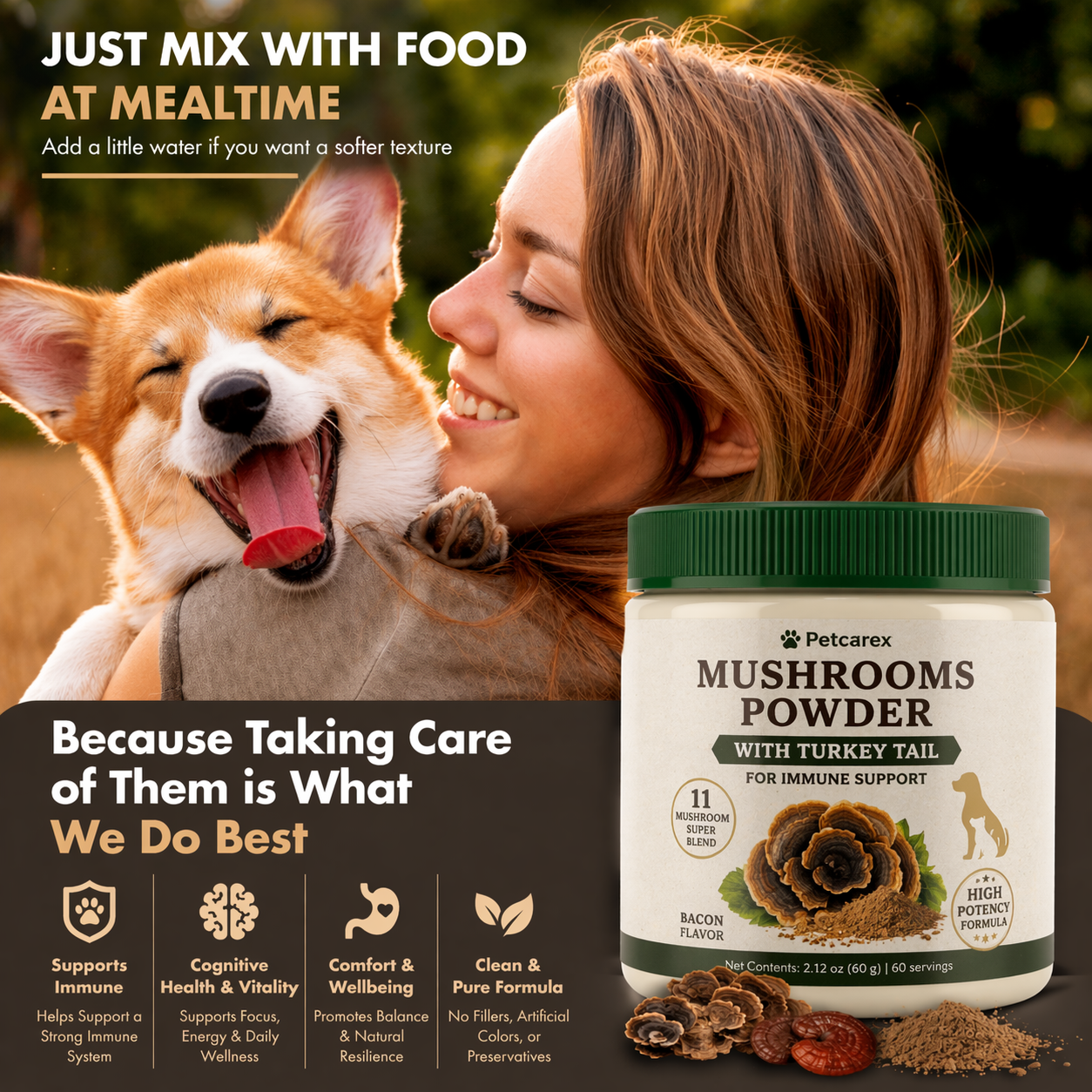
Of all the functional mushrooms that have entered the pet supplement market in recent years, turkey tail stands apart. It is not just a trending ingredient — it is the most clinically studied medicinal mushroom in veterinary medicine, with peer-reviewed research published in indexed journals and a documented history of use in human oncology spanning more than four decades.
This guide covers what turkey tail mushroom is, how it works in the canine body, what the clinical evidence actually shows, and how to use it appropriately as part of your dog’s health regimen.
What Is Turkey Tail Mushroom?
Turkey tail (Trametes versicolor) is a bracket fungus that grows on dead and decaying hardwood trees across North America, Europe, and Asia. Its common name comes from the distinctive fan-shaped caps with concentric bands of brown, tan, rust, and cream — a pattern that closely resembles the fanned tail of a wild turkey.
In traditional East Asian medicine, turkey tail has been used for centuries to support immune resilience and general vitality. In modern pharmacology, it is best known as the source of two closely studied bioactive compounds: PSK (polysaccharide-K, also called Krestin) and PSP (polysaccharopeptide). Both are classified as biological response modifiers — compounds that interact with and modulate immune function rather than simply suppressing or overstimulating it.
PSK has been used as an approved adjuvant cancer therapy in Japan since the 1970s, administered alongside conventional chemotherapy for gastric, colorectal, and lung cancers. PSP, isolated primarily from the mycelium, has been studied extensively in China and more recently in Western veterinary research.
How Turkey Tail Works in Dogs
The primary mechanism through which turkey tail exerts its effects is via beta-glucans — long-chain polysaccharide molecules that interact with specific receptors on immune cells. The most important of these are Dectin-1 and Toll-like receptors (TLRs), which are expressed on macrophages, dendritic cells, and natural killer (NK) cells. A 2019 study confirmed that these receptors are functionally active on canine immune cells, establishing a direct biological basis for the effects observed in dogs.
When beta-glucans from turkey tail bind to these receptors, they trigger a cascade of immune activity: macrophages become more active in identifying and engulfing pathogens and abnormal cells; natural killer cells increase their cytotoxic activity against tumor cells; T-lymphocytes — including both helper and cytotoxic subtypes — are primed to mount more effective responses.
Importantly, this process is described as immune modulation rather than simple immune stimulation. Turkey tail does not uniformly activate the immune system indiscriminately. It helps calibrate immune response, which matters significantly for dogs with cancer, chronic inflammatory conditions, or age-related immune decline.
Beyond immune function, turkey tail also acts as a prebiotic — feeding beneficial bacteria in the gut microbiome. A 2021 study published in Frontiers in Immunology found that turkey tail polysaccharides positively shifted gut microbiome composition, which has downstream effects on systemic immune health. Since a substantial proportion of the canine immune system resides in gut-associated lymphoid tissue, this gut-immune axis connection is clinically meaningful.
The Clinical Evidence for Dogs
The University of Pennsylvania Hemangiosarcoma Study
The most significant piece of canine-specific research is a clinical trial conducted at the University of Pennsylvania School of Veterinary Medicine, published in Evidence-Based Complementary and Alternative Medicine in 2012 by Brown and Reetz. The study enrolled 15 dogs with naturally occurring hemangiosarcoma — an aggressive malignancy of blood vessel walls that carries a historically poor prognosis, particularly in breeds such as Golden Retrievers, German Shepherds, and Flat-Coated Retrievers.
Dogs in the trial were administered I’m Yunity, a standardized PSP extract from turkey tail mushroom, at doses ranging from 25 mg/kg to 100 mg/kg per day following splenectomy (surgical removal of the spleen, which is the standard of care for splenic hemangiosarcoma). The findings showed that dogs receiving turkey tail extract had longer median survival times compared to historical controls, with the highest-dose group demonstrating the most notable results. No dose-limiting toxicity was observed even at 100 mg/kg per day, establishing a strong safety profile.
This study does not suggest that turkey tail cures hemangiosarcoma or replaces surgical intervention or chemotherapy. What it demonstrates is that PSP from turkey tail can function as a meaningful adjunct — potentially slowing metastasis and supporting immune surveillance during a period when the immune system is under significant stress.
Broader Immunological Research
Beyond the hemangiosarcoma trial, turkey tail’s mechanisms are supported by a substantial body of human and cross-species research. A 2012 systematic review of human clinical trials found that PSK improved survival outcomes when used alongside chemotherapy for several cancer types. Multiple studies have documented the ability of turkey tail polysaccharides to induce apoptosis (programmed cell death) in cancer cells, inhibit angiogenesis (the process by which tumors develop their own blood supply), and reduce DNA damage caused by carcinogens.
While direct application of human data to dogs requires caution, the underlying receptor biology — and the confirmed presence of Dectin-1 and TLR receptors in canine immune cells — provides a credible scientific basis for expecting similar effects across species.
Benefits of Turkey Tail Mushroom for Dogs
Immune System Support
For dogs of any age and health status, turkey tail offers broad-spectrum immune modulation. This is particularly relevant for senior dogs, whose immune function naturally declines with age (a process called immunosenescence); for dogs recovering from surgery or illness; and for dogs with chronic conditions that keep their immune systems in a state of ongoing activation.
The immune support provided by turkey tail is not the same as what a vaccine or antibiotic provides. It works over time, strengthening the immune system’s capacity to recognize and respond to threats rather than providing immediate targeted protection. Consistent daily supplementation is the appropriate model of use.
Cancer Support and Integrative Oncology
Turkey tail is increasingly included in integrative veterinary oncology protocols as an adjunct to conventional treatment. Its primary role in this context is to maintain immune function during chemotherapy (which can be immunosuppressive), support the body’s natural cancer surveillance mechanisms, and potentially slow the progression of metastatic disease.
It is critical to understand that turkey tail does not shrink tumors or replace veterinary cancer treatment. It should always be used alongside, not instead of, the treatment plan established by a veterinary oncologist. For dogs with hemangiosarcoma in particular, the evidence base is sufficient for many integrative veterinarians to recommend it as part of a post-surgical support protocol.
Gut Health and Microbiome Balance
A healthy gut microbiome is foundational to a well-functioning immune system. Turkey tail’s prebiotic activity feeds Lactobacillus and Bifidobacterium species — beneficial bacteria that support the intestinal barrier, regulate inflammatory signaling, and influence systemic immune tone. For dogs with gastrointestinal imbalance, a history of antibiotic use, chronic digestive issues, or stress-related gut disruption, turkey tail’s prebiotic properties represent a meaningful secondary benefit.
Support for Dogs with Allergies and Chronic Inflammation
Some practitioners use turkey tail for dogs with recurrent skin allergies, environmental sensitivities, or other conditions driven by chronic immune dysregulation. The logic is that by improving immune balance rather than simply suppressing it, turkey tail may help the immune system respond more appropriately to non-threatening stimuli. Formal clinical trials in this area for dogs are lacking, but the mechanism is plausible and the safety profile makes a supervised trial reasonable.
Senior Dog Wellness
Older dogs experience natural decline in immune responsiveness, reduced gut microbiome diversity, and increased vulnerability to infection and age-associated disease. Turkey tail’s ability to modulate immune function and support gut health addresses several aspects of this decline simultaneously. For aging dogs without specific active conditions, turkey tail can be a practical, low-risk addition to a preventive care routine.
Safety Profile and Side Effects
Turkey tail has an excellent safety record at standard supplement doses. The UPenn hemangiosarcoma study administered doses up to 100 mg/kg per day — far above what commercial supplements deliver — without observing dose-limiting toxicity. PSK has been used as a pharmaceutical agent in Japan for over 40 years with a well-documented safety profile in humans.
The most commonly reported side effect in dogs is mild, transient gastrointestinal upset — loose stools, gas, or occasional vomiting — typically occurring in the first three to seven days of supplementation as the gut microbiome adjusts. This can almost always be avoided or minimized by starting with a lower dose and increasing gradually over one to two weeks.
There are two populations of dogs for whom extra caution is warranted. First, dogs with diagnosed autoimmune conditions: because turkey tail stimulates immune activity, it could theoretically worsen conditions in which the immune system is already over-activated against the body’s own tissues. This does not mean it is contraindicated in all such dogs, but it does require a conversation with the treating veterinarian. Second, dogs on immunosuppressive medications (such as cyclosporine or corticosteroids) may experience interactions, as the opposing mechanisms of the drug and the supplement can complicate management. Always disclose all supplements to your veterinarian.
Raw turkey tail mushroom should not be given to dogs — it is poorly digestible, potentially irritating to the gastrointestinal tract, and lacks the extraction process that concentrates the active beta-glucan compounds. Prepared supplements in powder, capsule, or liquid extract form are the appropriate delivery vehicles.
How to Choose a Quality Turkey Tail Supplement
Product quality varies significantly in this category. Because supplements are not subject to the same regulatory oversight as pharmaceuticals, there is wide variation in the actual content of active compounds between products — even products that appear similar on the label.
When evaluating turkey tail supplements for dogs, consider the following:
Fruiting body vs. mycelium on grain. The fruiting body — the visible fan-shaped mushroom structure — contains higher concentrations of beta-glucans and is the source material used in most clinical research. Mycelium grown on grain substrates contains significant amounts of starch from the grain, which dilutes the concentration of active compounds. Products should specify that they use fruiting body extract or that active compound content has been standardized and verified.
Beta-glucan content. Look for products that list beta-glucan content as a percentage — ideally 30% or higher. This indicates that the manufacturer has tested for the active fraction and standardized the formulation, rather than simply grinding mushroom material and filling capsules.
Third-party testing. A Certificate of Analysis (COA) from an independent laboratory confirms that the product contains what the label claims, is free from contaminants (heavy metals, pesticides, microbial contamination), and has been produced according to quality standards.
Absence of unnecessary additives. High-quality supplements need no artificial colors, synthetic flavors, or filler ingredients. The mushroom extract itself should be the primary or sole active ingredient.
Dog-appropriate formulation. Products designed specifically for dogs will have appropriate dosing guidance based on body weight, which is important for achieving therapeutic levels without waste or risk.
Dosage and Administration
There is no universally established standard dose for turkey tail supplementation in dogs outside of the clinical trial setting. Most commercial products provide weight-based guidelines, and these should be followed as a starting point.
As a general principle, introduce turkey tail gradually — at approximately half the recommended dose for the first one to two weeks — to allow the gut microbiome to adjust and to confirm that the individual dog tolerates the supplement well. After this introductory period, increase to the full recommended dose.
Turkey tail can be given as a powder mixed into food, as capsules (either given directly or opened and mixed into food), or as a liquid extract added to meals. Mixing with food generally improves palatability and reduces the chance of gastrointestinal upset compared to administration on an empty stomach.
Results from turkey tail supplementation are not immediate. For immune maintenance purposes, consistent daily use over several weeks is required before the cumulative effects become apparent. For dogs with active health conditions, timelines should be discussed with a veterinarian.
When to Consult a Veterinarian
Turkey tail is a supplement, not a treatment. While it can be used as a preventive tool in healthy dogs without specific veterinary guidance, the following situations warrant a conversation with a veterinarian before starting:
Dogs with active cancer diagnoses, where turkey tail is being considered as part of an integrative protocol alongside surgery, chemotherapy, or radiation. The timing, dose, and interactions with other treatments should be coordinated with the treating oncologist.
Dogs with diagnosed autoimmune conditions, where immune-stimulating supplements require careful evaluation.
Dogs already taking prescription medications, particularly immunosuppressants or medications with known interactions with beta-glucan compounds.
Dogs with significant gastrointestinal disease, where any new supplement should be introduced with monitoring.
In all other cases — healthy adult dogs, senior dogs, dogs with minor immune challenges — turkey tail at standard commercial doses is generally considered safe to try under responsible owner monitoring.
Final Thoughts
Turkey tail mushroom occupies a unique position in the canine supplement landscape: it is one of the few functional mushrooms with genuine peer-reviewed clinical evidence in dogs, rather than theoretical benefit extrapolated entirely from human research. Its mechanisms are well understood, its safety profile is well established, and its applications span a range of canine health needs — from general immune maintenance in healthy dogs to adjunctive support in serious illness.
Like all supplements, it works best when quality is prioritized, dosing is appropriate, and it is used as part of a broader health strategy rather than in isolation. For dogs facing the challenges of cancer, aging, immune vulnerability, or gut dysbiosis, turkey tail is one of the more evidence-supported tools available to pet owners and integrative veterinary practitioners alike.

Leave a Reply